
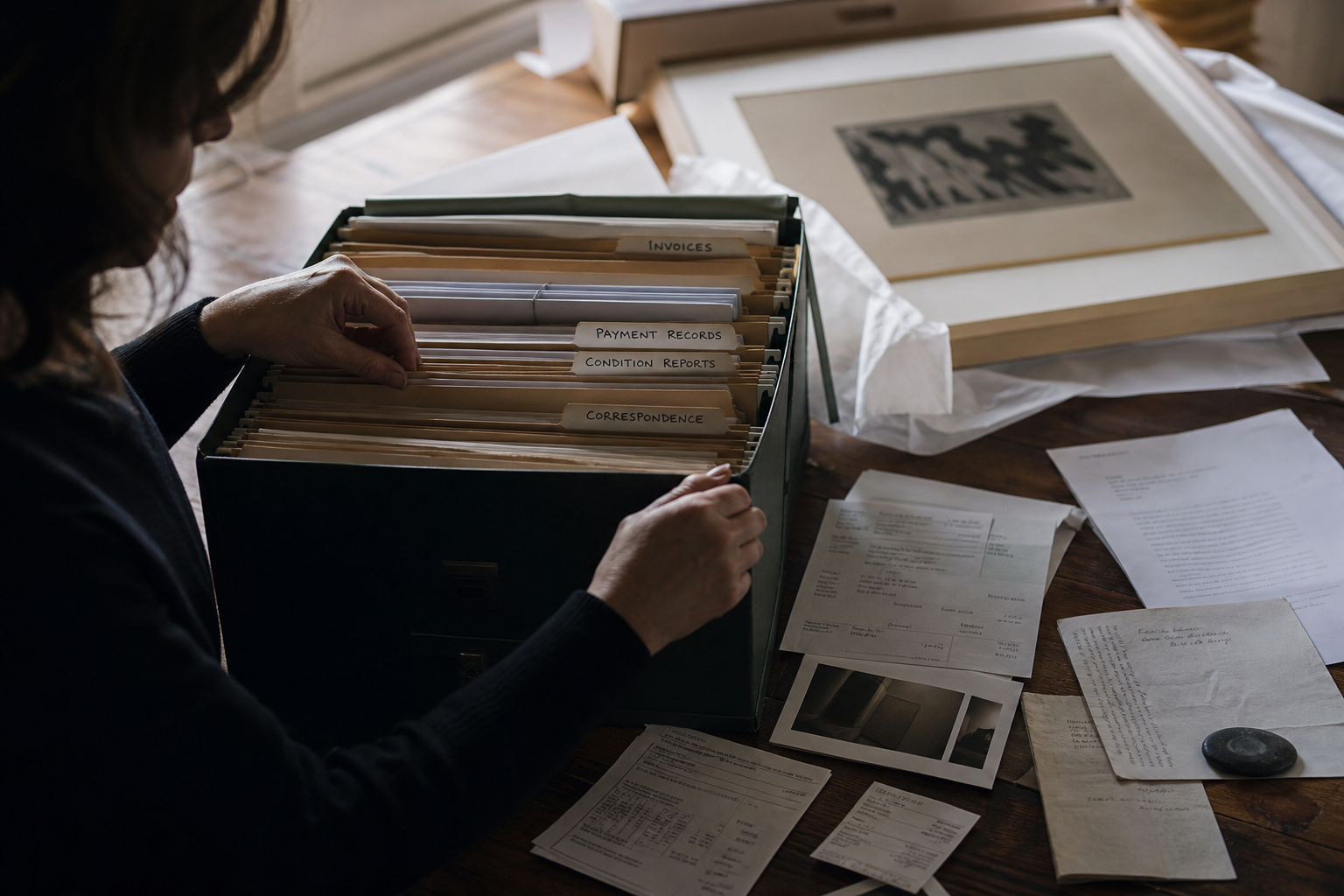
Every original-art purchase should leave you with an object-specific invoice and payment record. The invoice should identify seller and buyer, artist, title, date, medium, dimensions, edition if any, frame, price, taxes and fees, sale date, and payment status. Also preserve the listing, correspondence, current photographs, delivery record, and written condition information. Depending on the work, you may also receive provenance records, a certificate of authenticity, catalogue or inventory reference, edition or publisher documentation, conservation or treatment reports, customs paperwork, insurance documents, and frame or installation records. Not every authentic artwork has every document. Missing records should be described honestly, not replaced with invented certainty.
The invoice is the transaction spine
The invoice connects one buyer, one seller, one object, one price, and one date. It should state the seller’s legal identity and enough object detail to prevent confusion with another work. Ask for corrections before the transaction fades into email fragments.
A receipt proves payment but may not identify the object adequately. Keep both. Review what should be on an art invoice for field-level detail.
Provenance records ownership, not taste
Provenance may include prior invoices, bills of sale, gallery labels, collector records, exhibition loan forms, correspondence, estate or inventory numbers, auction catalogues, and transfer statements. The Smithsonian defines provenance as the history of who owned an object from creation to the present and notes that incomplete histories are common.
Record gaps rather than filling them with assumptions. A named prior owner is a claim until a document or reliable record supports it.
Certificates and authenticity records
A certificate can preserve an artist, estate, publisher, committee, or seller assertion. Record the issuer, authority, date, exact object identifiers, signature, image, and number. Keep correspondence used to verify the issuer.
A COA is not a substitute for provenance, invoice, or condition documentation. Some credible living artists do not issue certificates; their signed invoice and studio inventory record may be the stronger first-party trail.
Condition and treatment records
Sources
- Museum Handbook, Part II: Museum RecordsNational Park Service
- What Is Provenance?Smithsonian Institution
- A Guide to Provenance Research at the Archives of American ArtSmithsonian Archives of American Art
- What Visual and Graphic Artists Should Know about CopyrightU.S. Copyright Office
- Museum Handbook, Part III: Museum Collections UseNational Park Service