
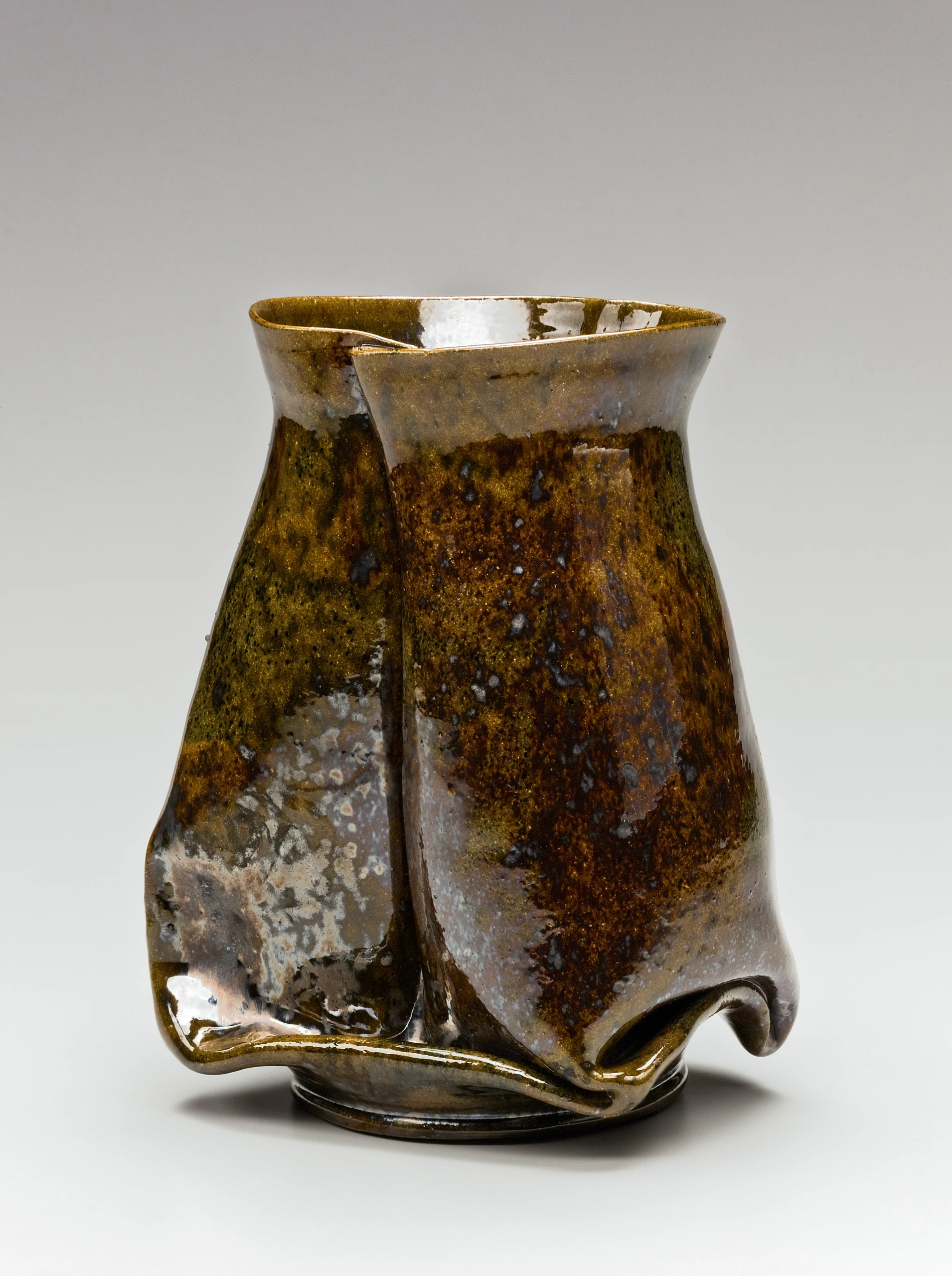
Start at the foot. Beneath the folds of George Ohr’s vase, a small circular base is still easy to see. Above it, the body spreads outward, bends inward and gathers into deep creases. At the lower right, a curled section encloses a dark pocket of space. The opening at the top is uneven too. A familiar vessel has acquired a succession of unexpected turns.
The earthenware vase in The Metropolitan Museum of Art dates from about 1897–1900 and stands just under eight inches high. That modest scale matters. The photograph can make its creased walls feel architectural, but this is an object small enough to examine closely, with changes of direction happening within a few inches.
Ohr worked in Biloxi, Mississippi. The Met describes a maker involved throughout production, from preparing clay to throwing, altering, glazing and firing his pots. His extremely thin vessel walls gave him material he could crimp, ruffle and twist. The potter’s skill remained essential when the shape departed from the roundness associated with the wheel.
Follow the long crease running down the front of this vase. It gives the eye a route from the rim toward the foot, while the broad surface beside it bows outward. Near the bottom, the direction changes again. A horizontal fold interrupts that downward movement. Looking becomes a small journey through surfaces that seem alternately stretched and gathered.
The thin edge around the opening offers another clue. It lets us see the clay as a wall with an inside and an outside, rather than simply as the outer boundary of a solid object. The glossy interior catches a bright reflection. Around the lower body, deeper folds create shadows that the broad surfaces cannot. Light helps make the construction legible.
The impression of softness is striking. A crease might suggest fabric, although the object is fired earthenware. The comparison comes from the way its sides bend and bunch, not from any cloth incorporated into the work. Ohr’s vessel asks us to reconcile the material we know with the pliability its shape recalls.
His training helps explain that tension. In Patti Carr Black’s history of the potter, published by Mississippi History Now, Ohr learned the trade from Joseph Fortuné Meyer in New Orleans, then traveled to learn from other American potteries. Back in Biloxi, he built his own workshop. Making practical wares and experimenting with delicate forms belonged to the same working life.