
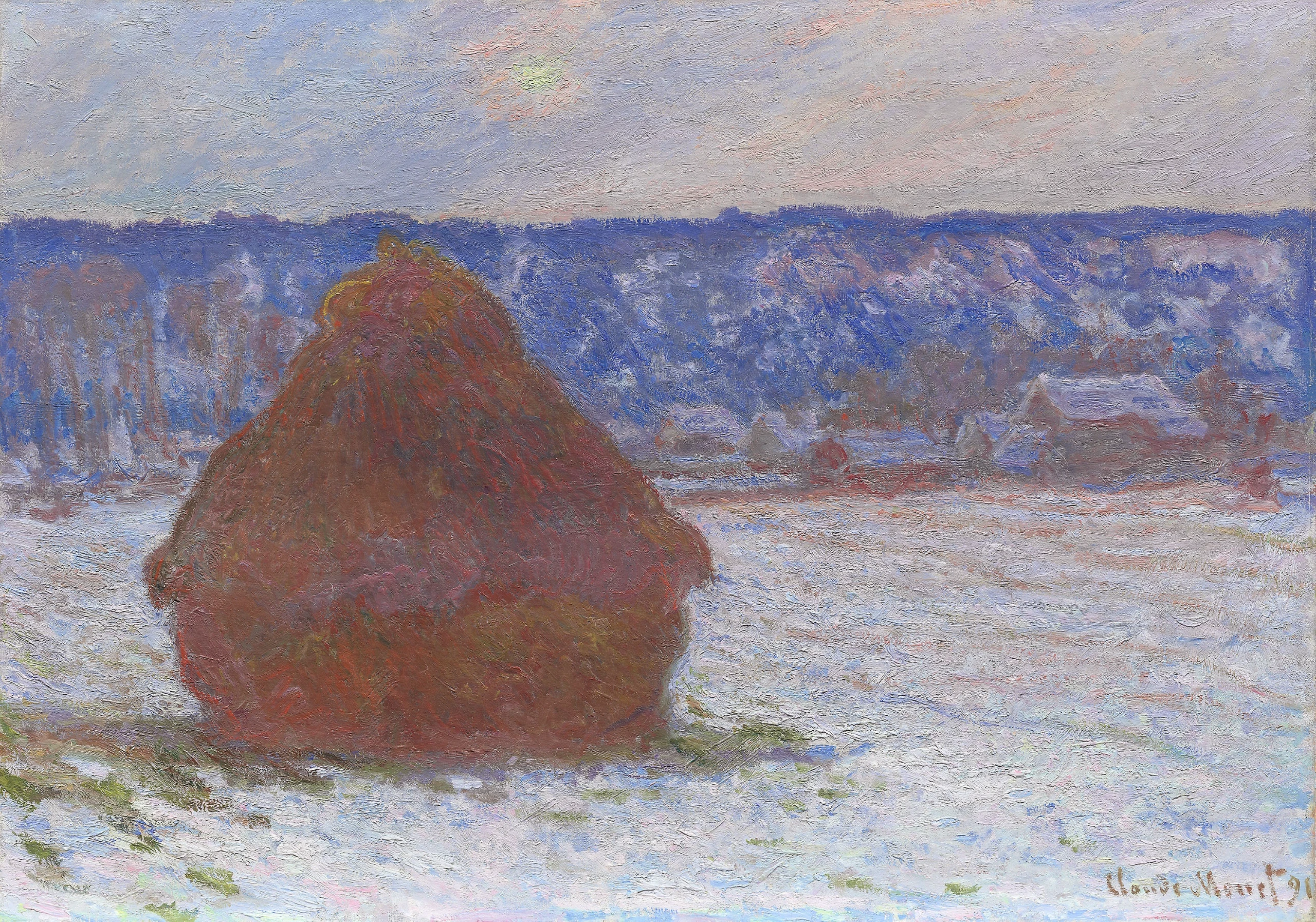
November offers a reason to look again at winter paintings, before snow becomes merely a shorthand for the season. In Claude Monet’s Stack of Wheat (Snow Effect, Overcast Day), the field seems pale at first glance. Stay with it, and that apparent whiteness breaks into blue, violet and warmer touches. The snow has become the most changeable thing in the picture.
Painted in 1890–91 and now in the Art Institute of Chicago, the work places one substantial stack against a low band of distant landscape. Its broad, rounded body gives the composition weight. Around it, the field spreads almost to the edges of the canvas. There is little incident to distract us from differences of color.
Start at the stack’s base. The cool tones gathered around it help the form settle into the ground. Then look farther across the foreground, where warmer strokes interrupt the blue-violet field. These small shifts keep the snow from becoming an empty surface. They give the eye something to travel through.
The title’s “overcast day” matters. This is a useful painting for noticing how much can happen without a brilliant sun or a spectacular sunset. The light feels dispersed, and the stack’s edges soften in places. Color does much of the work that a sharp outline might otherwise perform.
An earlier Monet makes the role of shadow easier to see. In The Magpie, painted in 1868–69, a bird perches on a gate in a snowy landscape near Étretat. Shadows extend across the foreground in pale blue-gray, setting cooler passages against the creamy light around them. The gate helps us read their direction, but their color gives the snow its particular sensation of daylight.
Writing about the painting for Artnet News, Katie White draws attention to Monet’s interest in perceived color: how something looks under particular conditions, rather than the color we habitually assign it. That distinction is helpful when looking at either painting. Knowing that snow is white can make us overlook what the painted surface actually contains.