
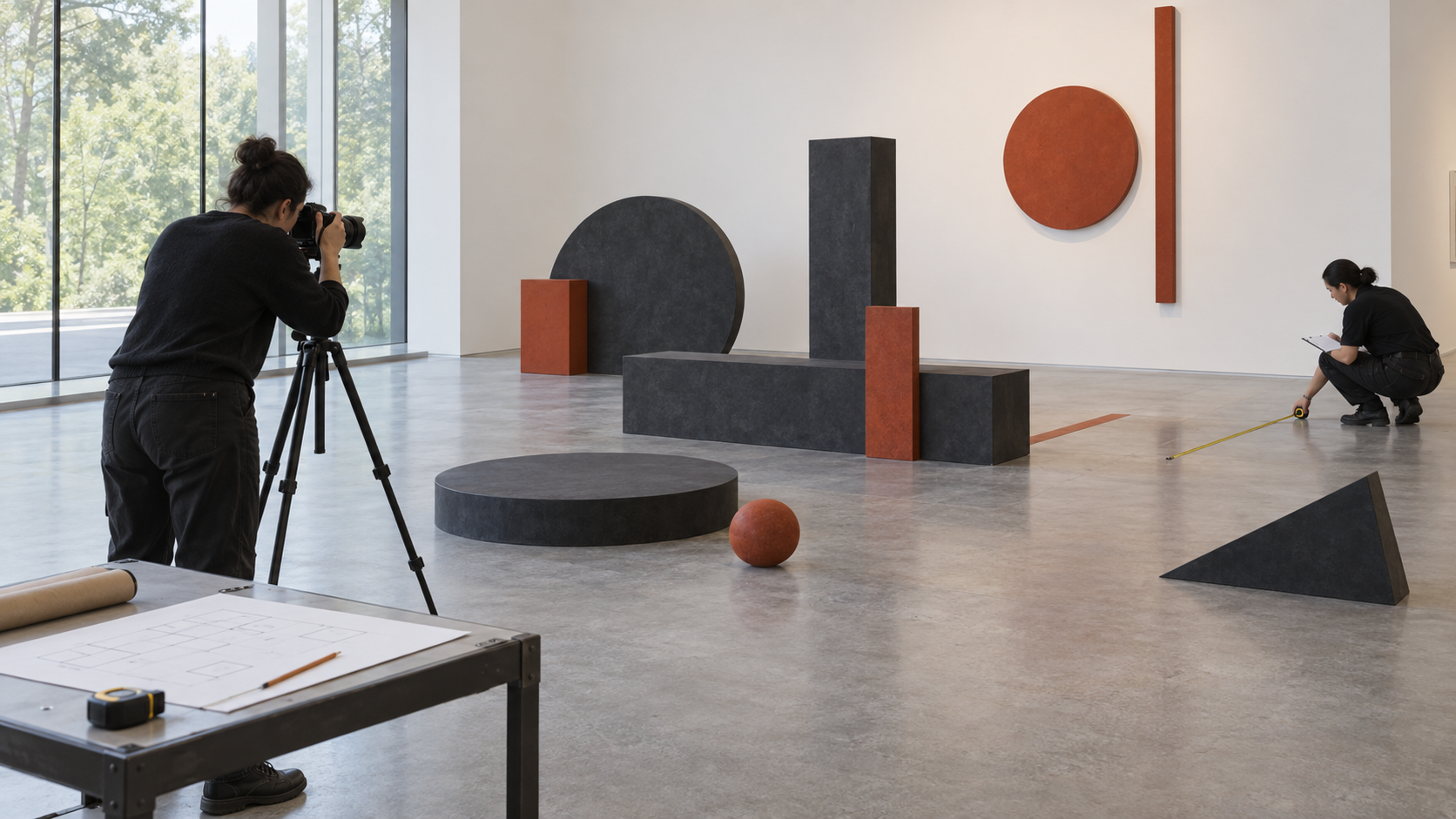
Record the work, not just the room
An installation photograph can be beautiful and still fail as an instruction. It may not show the distance between parts, the height of a suspended element, the route viewers take or which objects are replaceable. A collector who acquires an installation needs a component inventory and a plan for assembling it, but also an account of what makes a presentation faithful to the artist’s work.
The Guggenheim’s conservation program distinguishes a work’s installation requirements from an “iteration report” describing one specific manifestation. Its media-art examples are technologically complex, yet the principle extends to many physical installations: the identity of the work and the decisions made in this particular room are related records, not the same one.
Capture a specific iteration
Start with photographs and measured diagrams of an installed version. List every supplied component, its material and condition, and its position or relationship to other parts. Note lighting, sound, power, wall color or architectural features only if they matter to the work. Record who made placement decisions and why. Then preserve the installation sequence, packing method and any adjustments made on site. A future installer needs to know not only what happened, but whether a compromise was considered acceptable.
The Getty Conservation Institute’s case study of a complex installation shows why an artist interview can matter. Conservators combined technical and photographic records with the artist’s account of how the work should be mounted and what changes were integral to it. In another context, a seemingly damaged or perishable component might be intended to change. Assumptions based on ordinary object care could alter the artwork.
Keep the file usable
A Tate and S.M.A.K. installation-documentation project stresses the need to organize complex records so core information can be found by future conservators, curators and collection managers. For a private collection, that means a clear folder structure: artist instructions, acquisition terms, component inventory, reference images, diagrams, each iteration’s report, and subsequent condition or treatment records. Date every version.
Sources
- Time-Based Media ConservationGuggenheim Museum
- Research Conservation and Exhibition of a Contemporary Art InstallationGetty Conservation Institute
- Inside Installations documentation projectTate and S.M.A.K.