
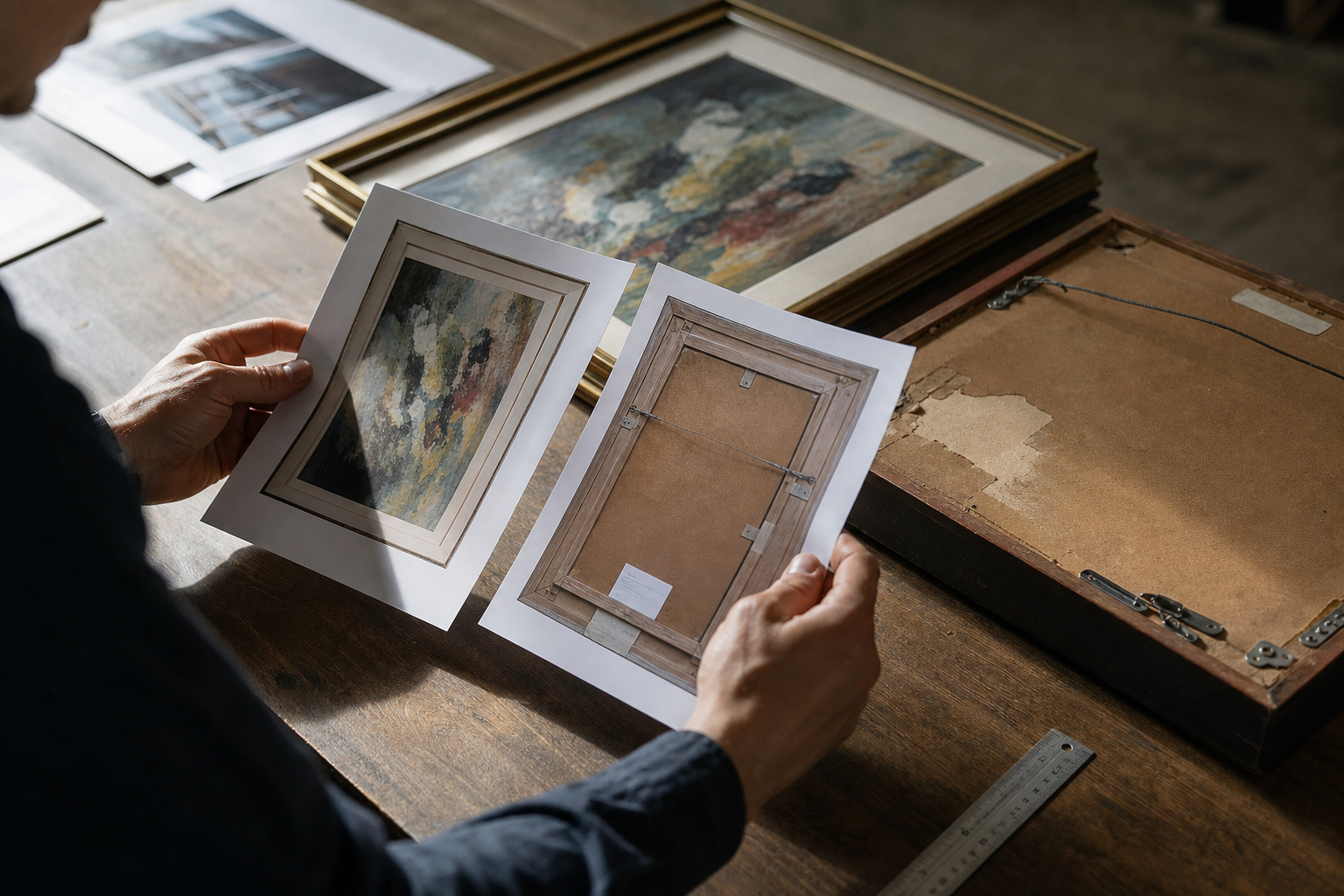
Request photographs that answer four questions: Is this the exact object? What is it made of and how is it constructed? What condition is visible? What marks, labels, frame, and hardware will arrive with it? At minimum ask for a straight-on full front, full reverse, all edges and corners, signature and inscriptions, labels and stamps, frame front and back, hanging hardware, a scale reference, and close-ups of every disclosed issue. For textured paintings add raking light; for reflective surfaces add angled views; for sculpture add a full rotation, base, joins, and attachments. Ask when the images were made and whether they show the current work.
1. Identity photographs
The full front should show the complete object without a room mockup, decorative crop, or mat obscuring its edges. The reverse should connect supports, labels, inscriptions, stretcher or panel, and repairs to the same object. Include a handwritten date or agreed reference in one current image when copied listings are a concern.
For editions, photograph the edition number, signature, publisher or workshop marks, blind stamps, and sheet edges. For a diptych or multi-part work, show all components together and separately.
2. Condition photographs
Request corners, edges, surface, tears, dents, scratches, cracks, lifting, staining, foxing, abrasion, planar distortion, losses, repairs, patches, fills, and retouching that the seller observes. Ask for a scale in close-ups so the size of an issue is not ambiguous.
A photograph documents appearance under particular light. It does not reveal every structural problem or prior treatment. Pair images with a dated written statement or report and ask who inspected the work.
3. Material and construction photographs
For canvas, show tacking or staple edges, stretcher or strainer, keys, backing board, labels, and frame fit. For works on paper, show sheet edges where safe, mounting or hinges if accessible, mat and backing, glazing, and any contact with the glazing. For sculpture, show base, underside, joins, welds, attachments, foundry marks, and stability points.
Do not ask an untrained seller to dismantle a fragile frame or remove a work from a mount. If hidden construction is consequential, arrange a qualified inspection.
4. Scale, color, and installation context
Sources
- Museum Handbook, Part II: Museum RecordsNational Park Service
- Museum Handbook, Part III: Museum Collections UseNational Park Service
- Condition ReportsChristie's
- Paper — Preservation Frequently Asked QuestionsLibrary of Congress
- Find a ProfessionalAmerican Institute for Conservation