
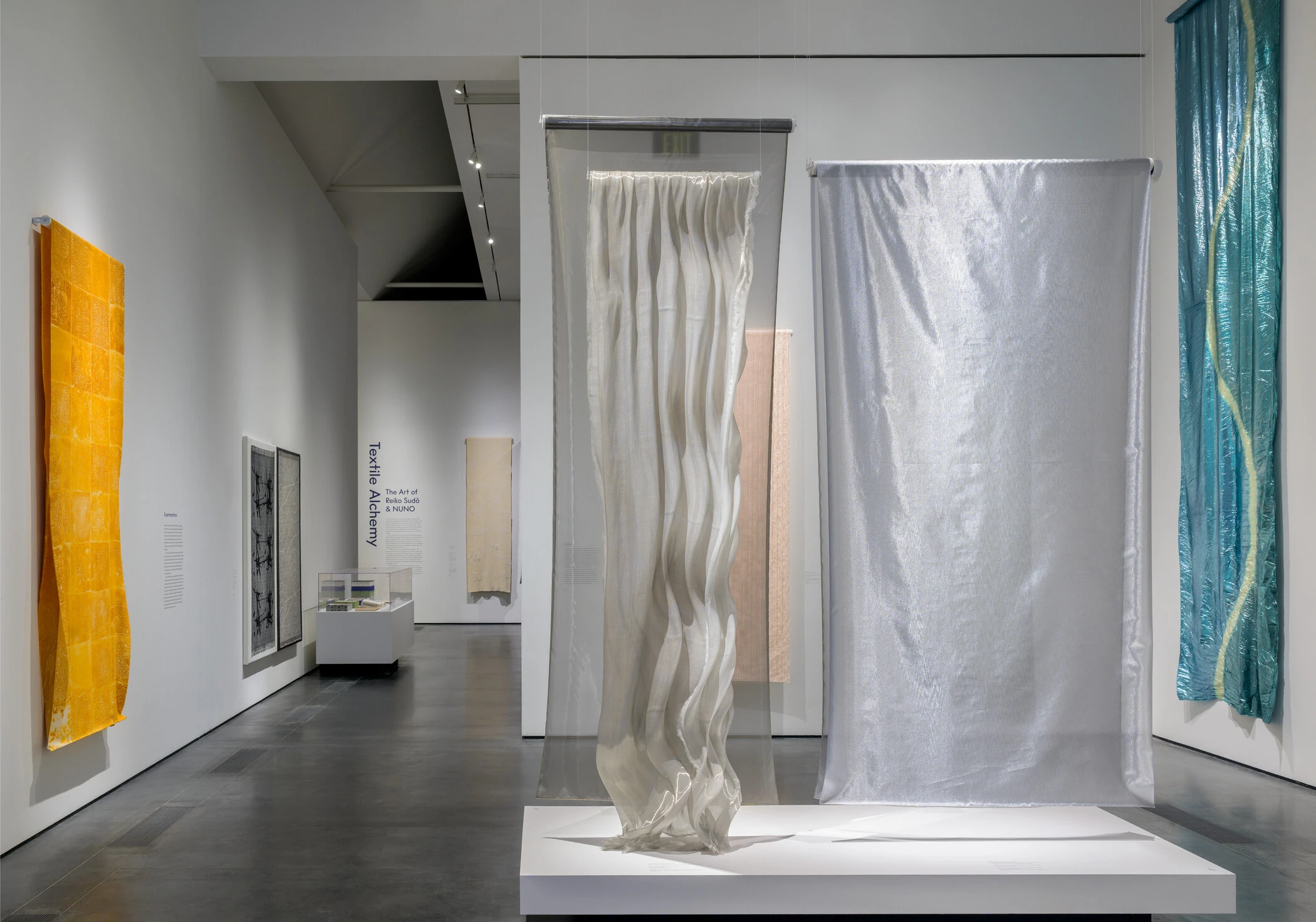
A computer-assisted loom has to stop so someone can slip a feather into the cloth. Then it starts again. In Reiko Sudō’s Feather Organza, that interruption is not a flaw to be engineered away. It is how the textile gets made.
The work offers a useful entrance to Textile Alchemy: The Art of Reiko Sudō & NUNO, at the Los Angeles County Museum of Art’s Resnick Pavilion through March 7, 2027. The exhibition brings together more than 100 textiles alongside tools, materials and prototypes. Its subject is not simply what unusual cloth can look like, but what people must invent to make it possible.
The hand inside the machine
Feather Organza, developed with the manufacturer Tsuguo, dates to 1993. According to LACMA’s exhibition labels, its silk is woven into pockets that hold individual feathers. The loom pauses repeatedly for their insertion by hand.
Calling that fabric either handmade or machine-made would leave out the interesting part. The machine provides a repeating structure; the inserted feathers do not become standardized threads. Their difference is retained inside the weave. What appears delicate depends on a carefully coordinated production process.
Sudō has described this territory herself. In a 2021 interview with ICON’s Francesca Perry, she discussed seeking a position between skilled handwork and the advantages of machinery. Perry’s reporting also describes NUNO’s collaborations with family-run factories specializing in different techniques. Innovation, in this account, is less a solitary designer’s flash of inspiration than a question worked through with other people.
Metal that still behaves like cloth
Another NUNO textile complicates the idea that a material has a fixed character. Stainless Steel Gloss, first issued in 1990, uses polyester cloth coated with particles of iron, nickel and chrome. LACMA identifies the process as sputter plating, adapted from automotive manufacturing.