
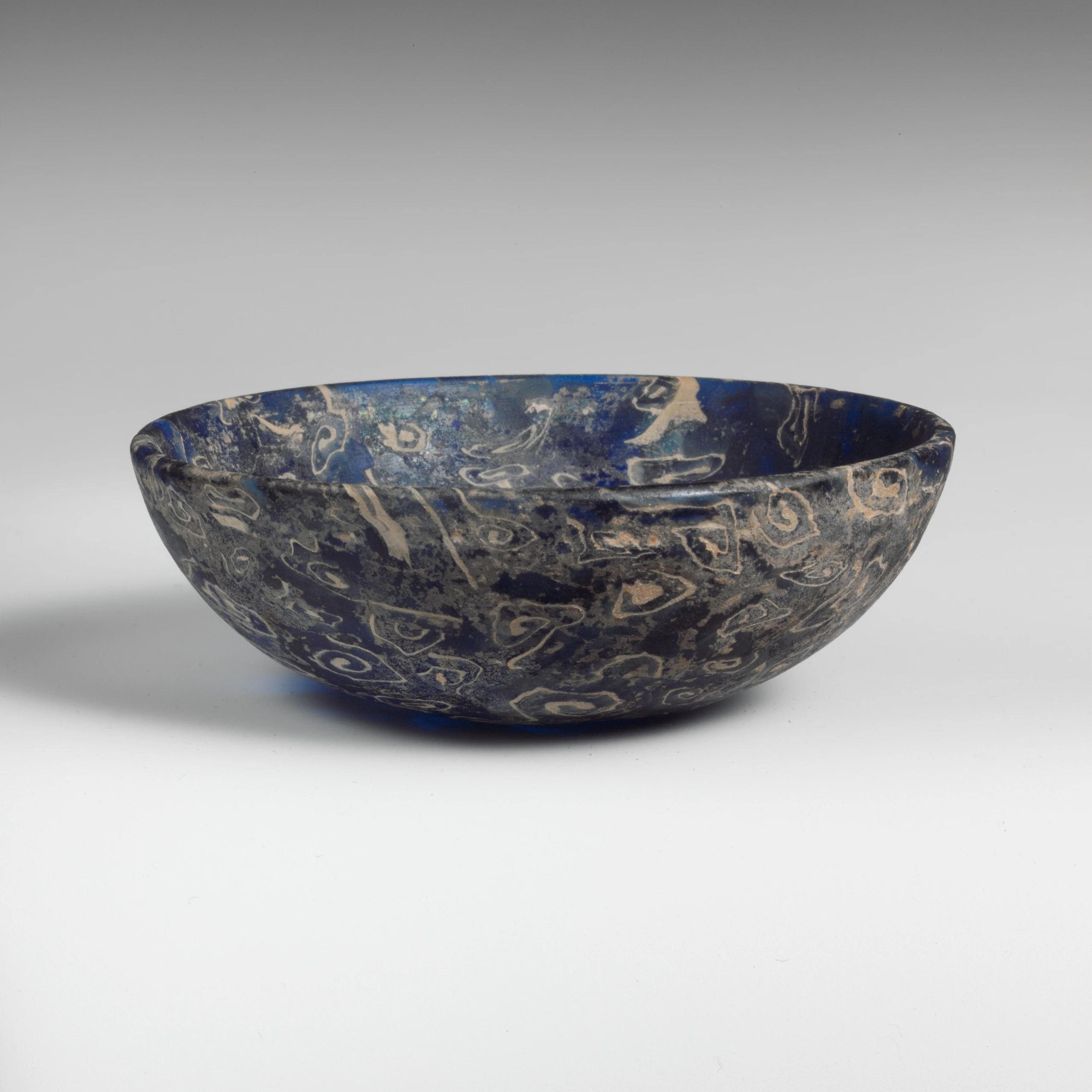
A white spiral can look like a mark made by a hand moving across a blue surface. On a small Roman bowl in The Metropolitan Museum of Art, that is a tempting but misleading way to read the decoration. The pale curls are not brushstrokes added to a finished vessel. They belong to the glass itself.
The bowl is only 3.3 centimeters high and 8.9 centimeters across. The Met dates it to the late first century BCE–early first century CE and identifies it as Roman, probably Italian. Its limited palette gives the eye a clear problem to work on: how did so many white spirals get inside one blue wall?
The museum's description supplies the first clue. The bowl contains polygonal sections of a patterned glass rod, or cane, with a white spiral in a cobalt-blue ground. Those sections are the units from which the object was built. What reads from a distance as ornament becomes, closer up, evidence of assembly.
In the mosaic-glass technique described by the Met's specialists, makers first created patterned canes and stretched them, reducing the scale of the design. They cut the canes into sections or strips and arranged the pieces into a flat disk. Heat fused the parts together; further heating allowed the disk to sag over or into a mold. The pattern therefore existed before the vessel had its curved shape.
That sequence matters. We often imagine a bowl being formed first and decorated afterward. Here the making of the image and the making of the container cannot be neatly separated. A spiral was already present in a piece of glass before that piece took its place beside another. The bowl gives those repeated units a continuous surface.
Repeating a motif does not produce a uniform-looking surface. In the museum's photograph, some curls are compact while others seem stretched or partly lost among neighboring shapes. The blue changes in depth; the surface is not pristine. The Met records pitting, dulling and iridescent weathering. What we see now combines the intended pattern with the material's subsequent history.
Heat was not the final operation. The museum also identifies rotary grinding marks inside this particular bowl. Its account of mosaic manufacture explains that edges and interiors generally needed finishing to smooth irregularities. The finished object resulted from both hot assembly and cold work. Its small size does not make the sequence simple.