
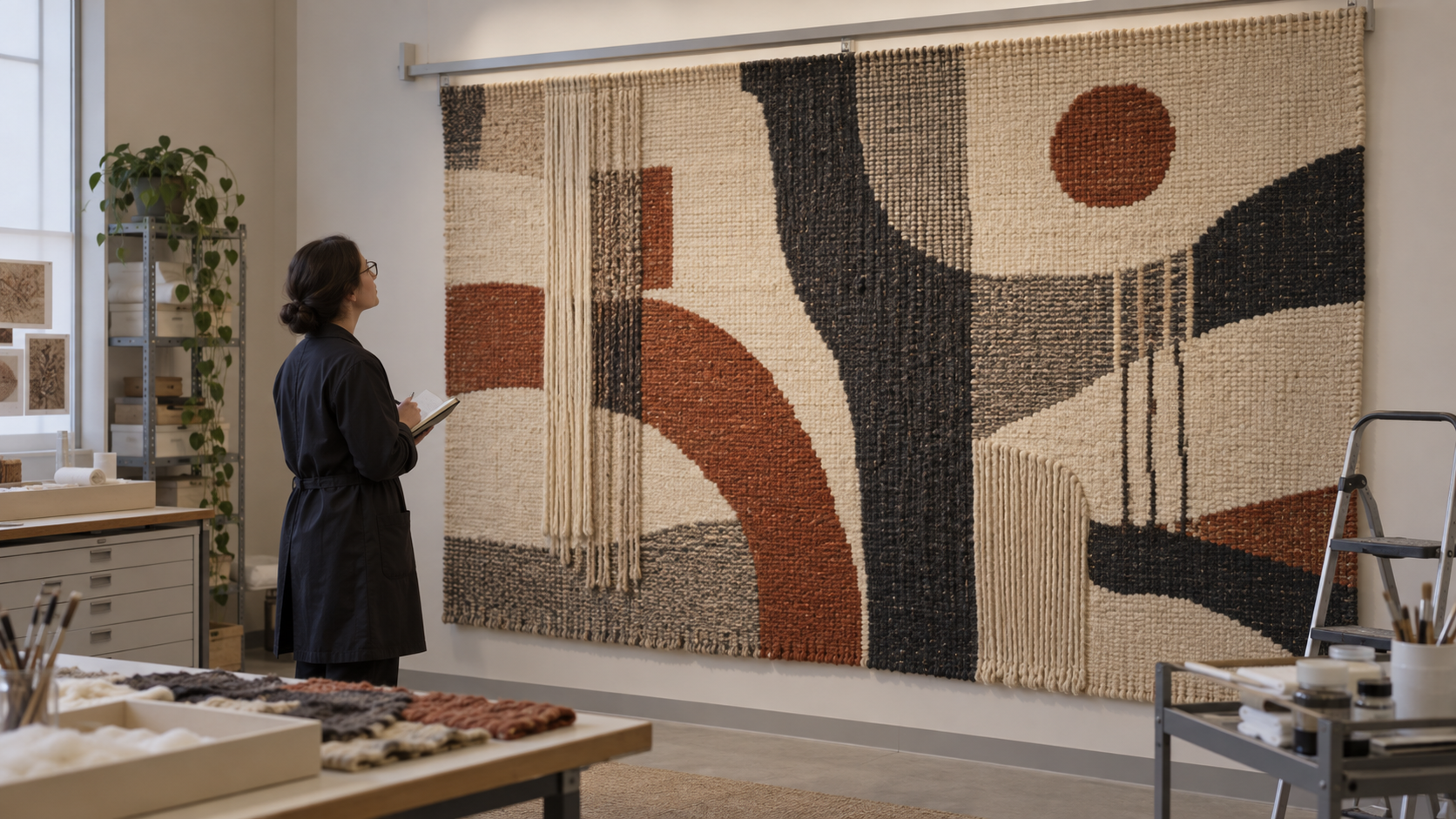
Gravity becomes a condition factor
A flat textile may look stable when first hung. Yet its own weight is always acting on the upper edge, stitches and vulnerable areas. The Canadian Conservation Institute’s guidance on flat textiles warns that rings attached only at points along the top can create uneven strain and distortion. Tacks or nails are not a substitute for a mount: they can tear or stain a textile.
The Institute describes a distributed support system for large, sound textiles that can bear their own weight. It also names its limit: a very thin, weak or fragile textile is not a candidate for that method. The practical principle is broader than one type of fastener. A hanging system has to spread load over the right area without asking damaged material to hold itself up.
The object determines the mount
For a small, lightweight textile, CCI’s mounting guidance discusses a rigid, fabric-covered support and warns against mounting a soiled or poor-condition object without specialist advice. An oversized tapestry, quilt or contemporary fiber work may need a very different solution. Some works also include intentional folds, loose threads, three-dimensional elements or artist-specified installation methods. Flattening those features to fit a standard frame could change the work as much as leaving it unsupported.
The Institute’s preventive-conservation guidelines also address light, handling, display duration and storage. Those conditions matter together. A well-supported textile can still be exposed to damaging light or dust; a gently lit work can still be strained by a narrow rod or a few hooks.
Sources
- Velcro Support System for TextilesCanadian Conservation Institute
- Mounting Small Light Flat TextilesCanadian Conservation Institute
- Caring for Textiles and CostumesCanadian Conservation Institute