
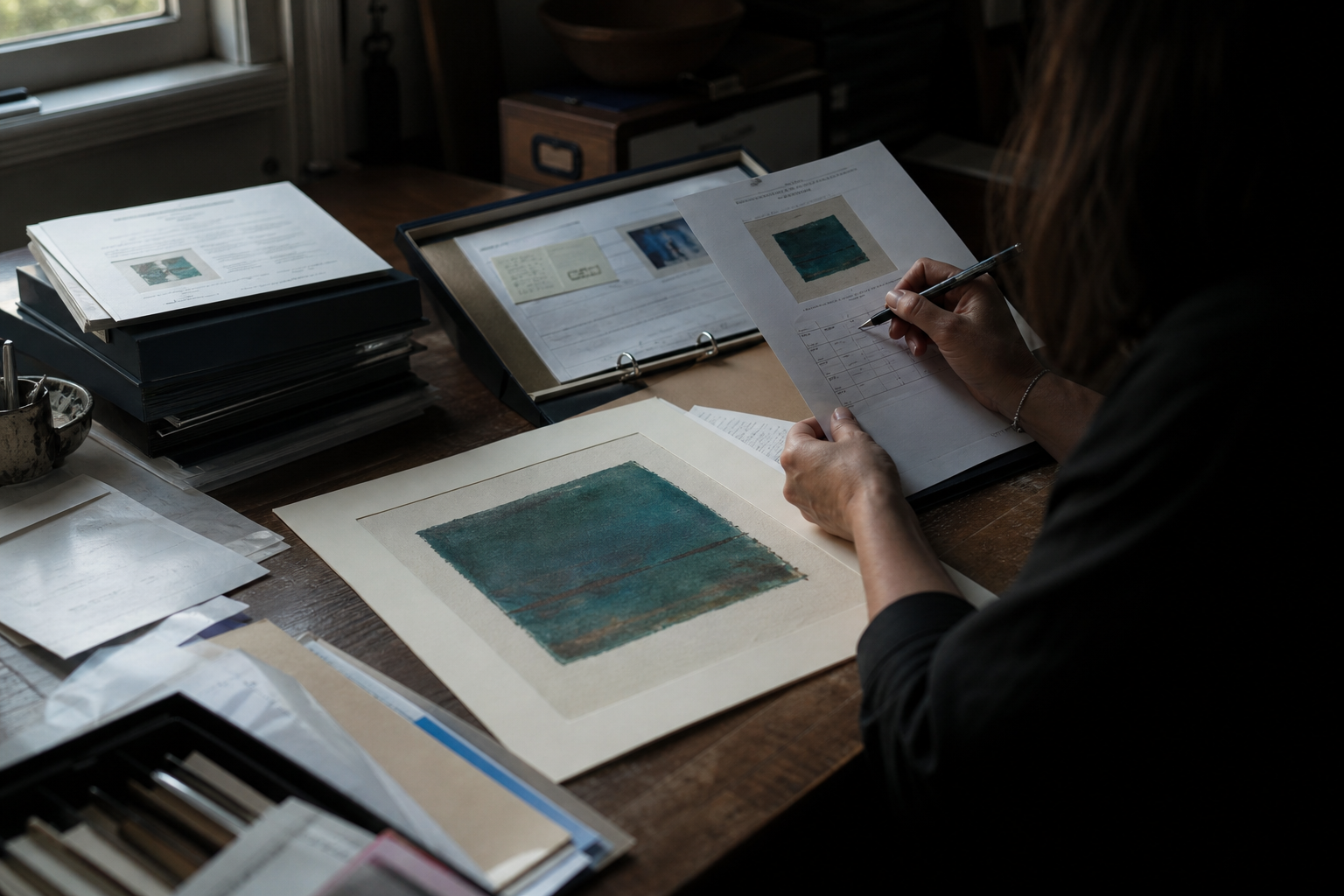
A certificate of authenticity proves, at minimum, that a named issuer made a documented claim about a described artwork on a certain date. It does not become conclusive merely because it says ‘authentic.’ Its usefulness depends on who issued it, what authority that person or organization has, how precisely it identifies the object, what claim it actually makes, whether the document is itself traceable, and whether the physical work matches it. A certificate from a living artist or authorized estate can be meaningful first-party evidence. A generic seller-produced card with no object identifiers or verifiable issuer may add very little. A COA does not replace an invoice, provenance record, condition report, or physical examination.
Read the issuer before the word authenticity
Identify the artist, estate, foundation, authentication committee, publisher, gallery, prior owner, or seller who issued the document. Then ask why that issuer is qualified or authorized to make the claim. The artist is a primary source for their own work; an authorized estate may maintain records; a reseller may only repeat information received from someone else.
Classification matters. An artist-issued certificate remains first-party evidence, not independent evidence. That does not make it worthless—it makes its source and scope visible.
Make sure it identifies one object
A useful certificate records artist, title, date, medium, dimensions, edition if any, signature or inscriptions, and a unique inventory, registration, or image reference. It should name and sign the issuer and include an issue date. Compare every field with the invoice, listing, photographs, and artwork.
A certificate that could describe any similarly sized painting is weak object-specific documentation. A mismatch in title punctuation may be harmless; a different medium, dimensions, image, or edition number needs resolution.
Ask what claim the document makes
Some certificates assert authorship. Others certify edition production, print publisher records, studio inventory, or a seller’s belief. Some contain qualifications or exclusions. Do not summarize every document as ‘proves authenticity’ when its language is narrower.
Review Invoice vs COA vs Provenance: an invoice records the transaction; provenance records ownership history; a condition report records observed condition; a COA records an authenticity-related assertion. One document can contain several kinds of information, but the functions remain distinct.
Sources
- Museum Handbook, Part II: Museum RecordsNational Park Service
- What Is Provenance?Smithsonian Institution
- A Guide to Provenance Research at the Archives of American ArtSmithsonian Archives of American Art
- What Visual and Graphic Artists Should Know about CopyrightU.S. Copyright Office