
The file is only part of the work
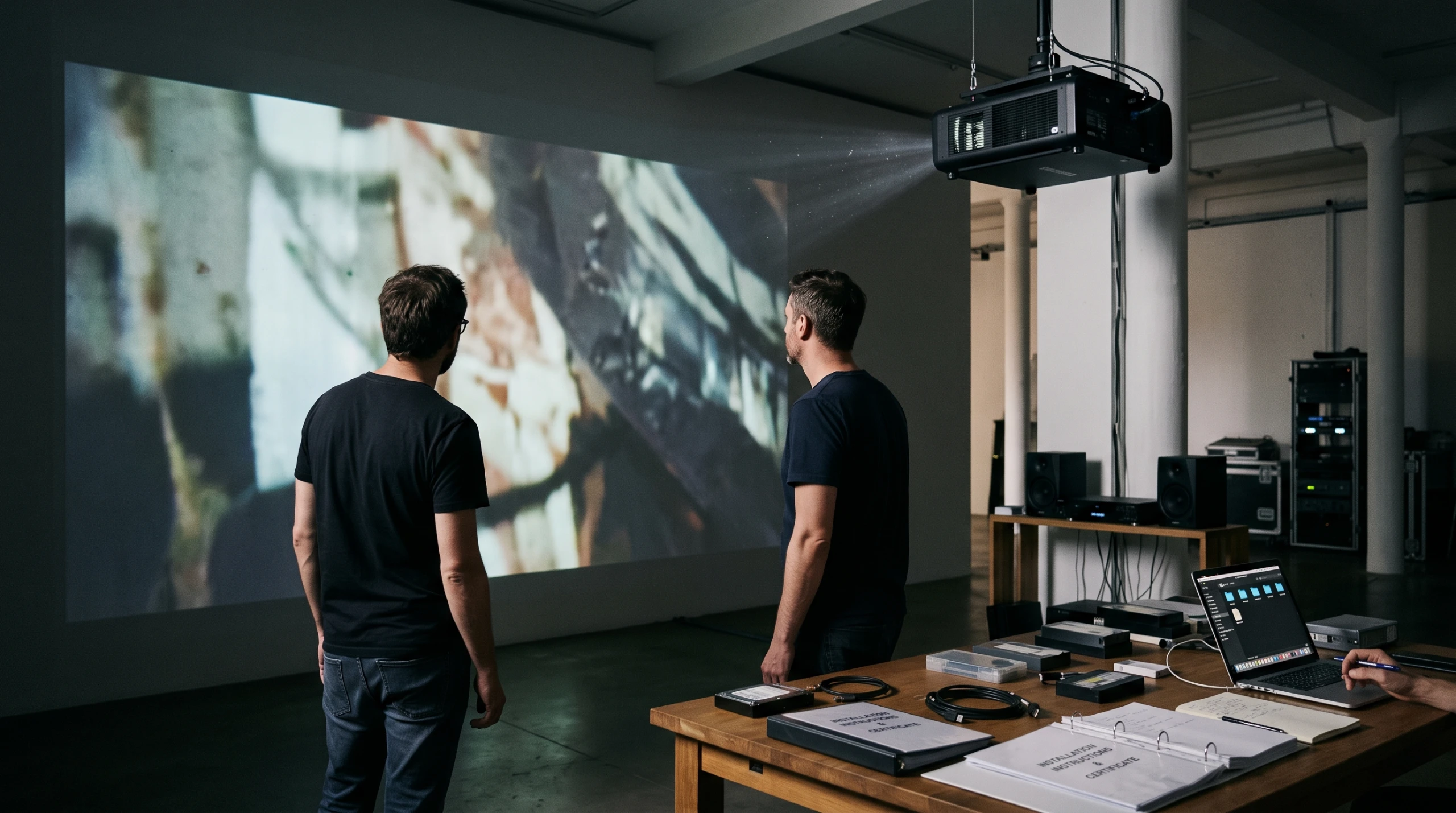
You can watch a clip on a laptop and still know very little about the artwork being offered. A video artwork may be a single-channel work designed for a monitor, a projection that depends on the room, or a multi-channel installation with synchronized sound and images. Its edition and certificate may define what is being acquired; its installation instructions may define what viewers are meant to experience.
MoMA media conservator Kate Lewis describes receiving, at acquisition, a media carrier together with a certificate and installation instructions. Her team assesses the media, watches and listens to it in full, and reviews how it should be translated into a display. In some works, the playback equipment is itself a visible sculptural component. In others, a particular technology may be specified even if the viewer barely notices it. MoMA's account of media conservation makes clear why a digital file and a still image are inadequate descriptions of the whole object.
Installation is part of stewardship
The collaborative Matters in Media Art project notes that time-based works are often fully realized only when installed. A collector should therefore ask for the display specifications before committing to a space. How many screens or projectors are needed? What are the intended dimensions, aspect ratio, sound arrangement and light conditions? Is a particular model of monitor essential, or can an equivalent be used? Does the work require a technician, and who can approve a change when a component fails?
These are not merely practical questions about furnishing a room. They help distinguish an authorized presentation of the work from a convenient playback of its content. If a seller cannot provide the instructions or explain the role of the equipment, that absence is something to resolve before purchase, not after delivery.
A format can become obsolete
Video formats and playback devices age. In MoMA's account of digitizing its video collection, conservator Peter Oleksik explains that older carriers can become fragile or unplayable and that migration to a newer format requires care for the original signal and the artist's intent. The museum reconstructed the histories of different copies before deciding which tapes to transfer. A cleaner-looking file would not automatically have been a truer version of a work.
Sources
- Digitizing MoMA's Video CollectionThe Museum of Modern Art
- Matters in Media ArtThe Museum of Modern Art
- What Does a Media Conservator Do?The Museum of Modern Art