
The form carries the idea
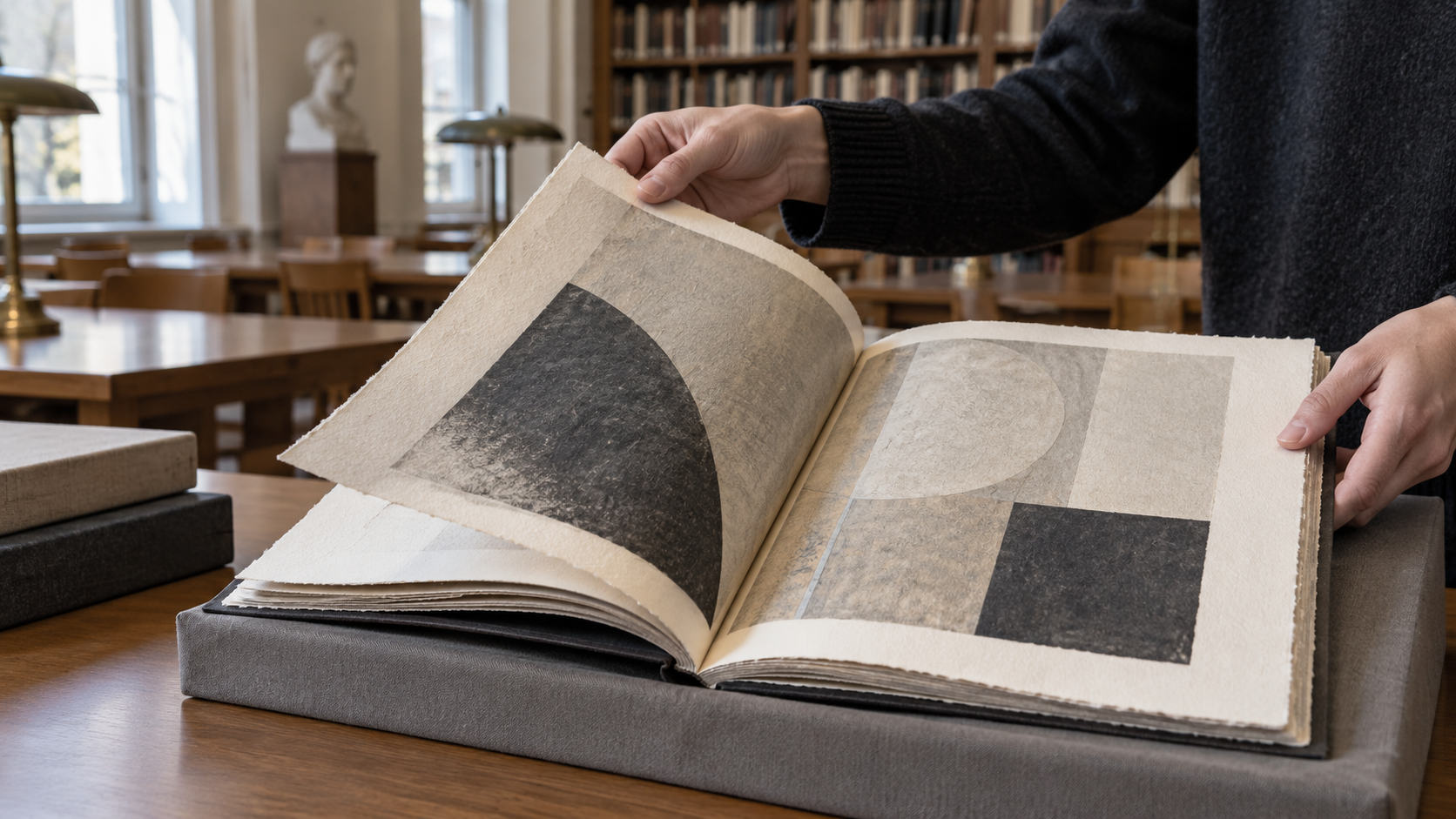
The Victoria and Albert Museum’s Artists and the Book collection asks what happens when an artist uses the book as an artistic practice in its own right. The answer can range from a duplicated pamphlet to a complex three-dimensional construction. A lavish binding is not a requirement. The work may depend on the order in which pages are encountered, how a reader holds it, or how ordinary printing puts it into circulation.
MoMA’s artist’s book term page includes examples whose status as art comes from conception and design, not from serving as a secondary record of a painting. A museum’s exhibition catalogue can be an excellent research source, yet it is usually a document *about* works. An artist’s book can be one of the works.
What the collector is actually buying
Look beyond the cover photograph. Is this a unique object, a numbered edition, or an open publication? Is the signed component the book, a loose print, or a label? Does the copy include inserts, a dust jacket, box, wrapper or separate material that belongs to the work? If an edition was published in more than one state, identify the one on offer. Ask for images of the binding, edges, interior sequence and any colophon, alongside a condition account.
MoMA’s essay on Noriko Ambe’s artist books describes books that stand as artworks rather than mass-produced art books or catalogues. It also shows why a generic title match is insufficient: the treatment of each physical book can differ. The particulars of the offered copy therefore matter as much as the title.
Display and handling are part of ownership
Sources
- Artists and the BookVictoria and Albert Museum
- Artist’s book — art termMuseum of Modern Art
- Taking a Slice Out of Modern Art: The Artists’ Books of Noriko AmbeMuseum of Modern Art