
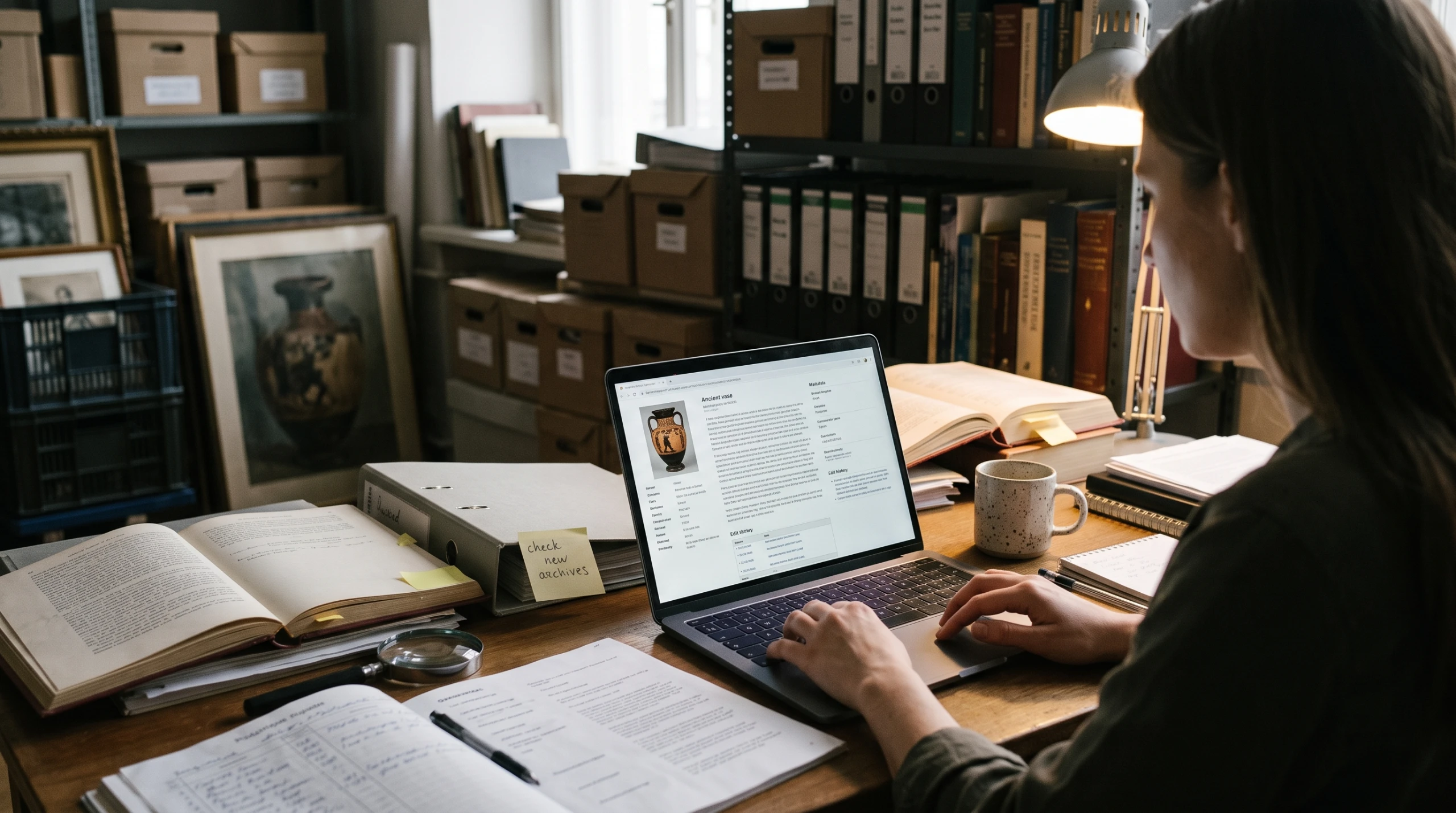
A collection record is living scholarship
An online museum page looks official, and it is. It may carry an accession number, maker, title, date, dimensions, materials, credit line, exhibition history and provenance. But official does not mean frozen. The Metropolitan Museum of Art says it continually researches works across its collections and updates public records as new information becomes available. Archives can open, scholarship can appear, scientific analysis can contribute evidence, and people outside the museum can share information. The record changes because the museum's understanding changes, not because a web editor is casually rewriting history. The Met explains its process here.
This is especially visible in provenance. An ownership chain assembled from catalogues, dealer records and correspondence may have gaps. A newly available archive can identify an owner, clarify a transfer or challenge an earlier assumption. A museum may then qualify, extend or correct the online chain. The National Gallery of Art likewise describes provenance research as ongoing scholarship rather than a one-time entry. Its provenance account is a reminder that the current record represents the evidence currently assembled.
What might change?
A maker's name can move from an unqualified attribution to “attributed to,” or the reverse, as research develops. A date range may narrow. An object description may gain technical information. An exhibition or bibliography may be added. Provenance can expand or become more qualified. Museums also revise interpretation as they consult communities, compare archives and reassess the language used to describe a work.
Not every change has the same meaning. Correcting a typo in a title is different from revising an attribution or inserting a previously unknown owner. A collector using a museum record to research a related work should locate the precise field that supports the claim and avoid treating the whole page as blanket proof.
Sources
- A Heron — object recordThe Metropolitan Museum of Art
- About The Met's Collecting PracticesThe Metropolitan Museum of Art
- Provenance at the National Gallery of ArtNational Gallery of Art