
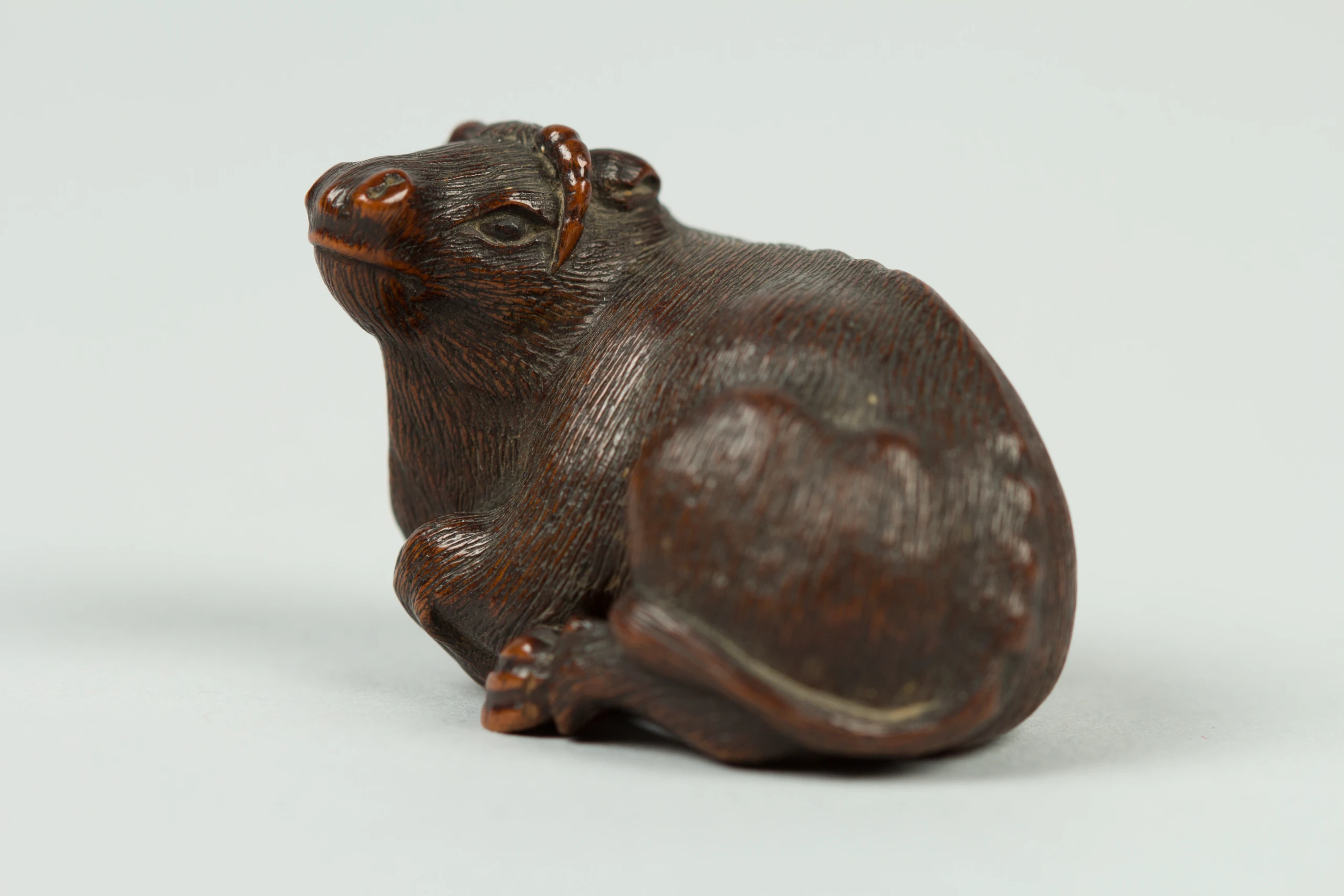
The ox has settled its weight into a compact brown shape. Its legs fold close to its body; fine grooves describe the hair; the head turns enough to interrupt the rounded outline. In the Metropolitan Museum of Art’s photograph, the carving can seem substantial. The museum’s measurements restore its real scale: just 2.9 centimeters high and 4.1 centimeters wide.
This eighteenth-century Japanese object is a netsuke, a toggle used with clothing. It belongs to a category of sculpture in which being small was not an accommodation to limited space. Smallness was part of the assignment. The object had to work beside a moving body, against fabric, attached to a cord.
That practical history changes how the ox looks. Its folded limbs are not merely a convincing animal pose. They also contribute to the compact contour expected of an object that passed behind a sash. The Kyoto Seishu Netsuke Art Museum explains that protruding elements could catch on a kimono or obi, and that carvers fitted animals’ limbs into rounded forms. A restraint imposed by clothing became a sculptural opportunity: how much life could a maker convey without sending a leg or horn far into space?
A small part of a larger system
The wooden ox did not carry medicine, tobacco or seals inside itself. It helped secure the container that did. Suspended accessories, collectively called sagemono, hung from cords at the obi. An inro, one kind of container, consisted of fitted compartments. The netsuke anchored the arrangement; a sliding bead called an ojime helped keep the container closed.
Seen alone, the ox conceals that partnership. A museum photograph shows a self-contained artwork, while its historical function depended on other things: cord, container, sash and wearer. Reconstructing the arrangement mentally does not make the carving less artistic. It reveals how much its design had to accomplish beyond looking persuasive from the front.
The back matters. So does the bottom. Katabori netsuke, the sculptural type representing figures and objects, were worked in the round, including surfaces that a conventional display might leave invisible. The Met supplies an underside photograph of this ox: the folded feet and textured belly continue the animal where a viewer might otherwise expect a plain base.